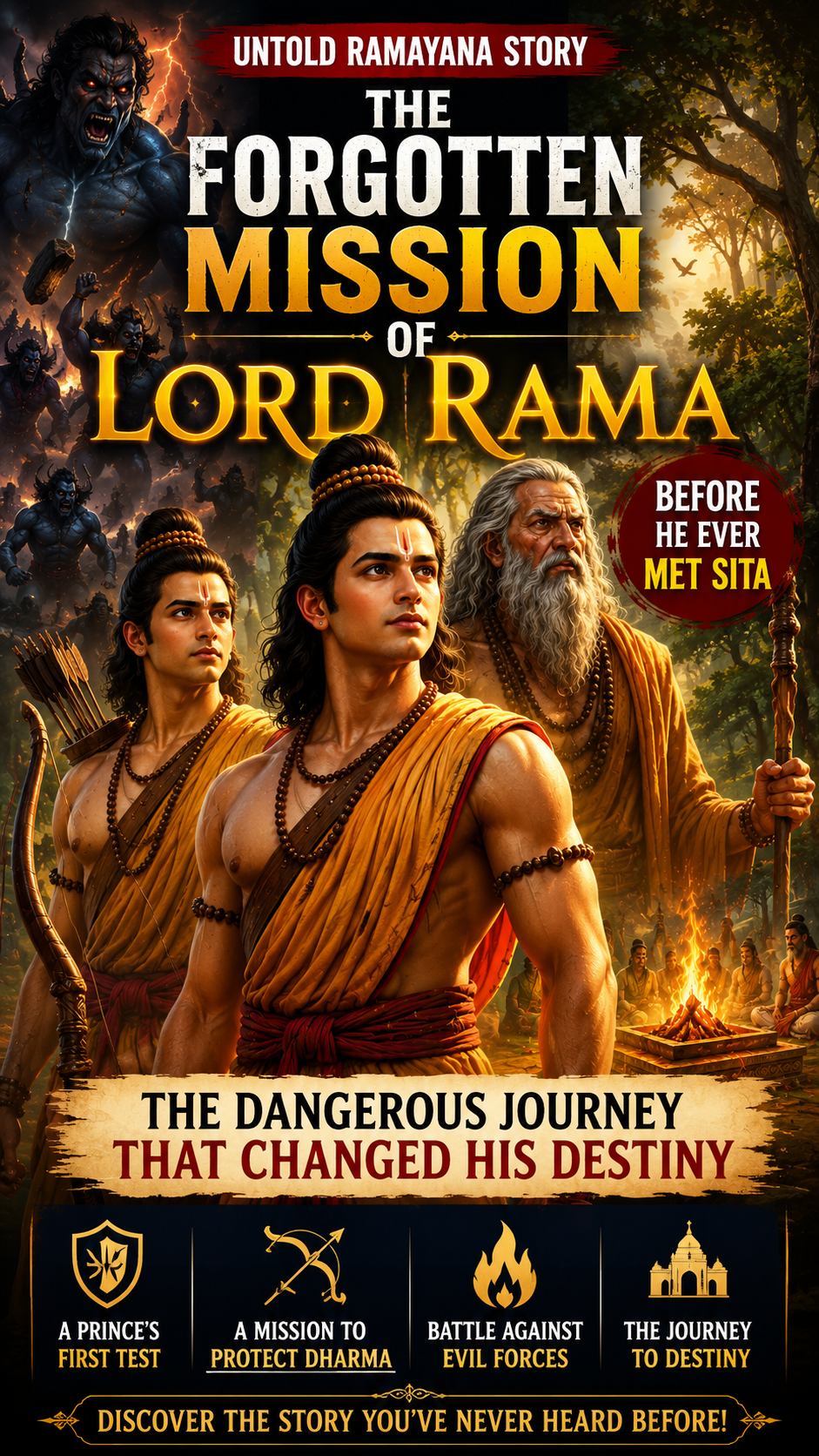
Before Ravana. Before exile. Before Sita. A mysterious sage walked into Ayodhya and asked King Dasharatha for the one thing no father wanted to give — young Rama himself.
What if I told you that Lord Rama's greatest test did not begin with Ravana? Not with exile. Not with the golden deer. Not even with the kidnapping of Sita. It began years earlier — when a mysterious sage walked into Ayodhya and asked King Dasharatha for something so shocking that the entire royal court fell silent. He didn't ask for gold. He didn't ask for land. He didn't ask for an army. He asked for Rama. And that single request would change the course of history forever.
The morning seemed ordinary. King Dasharatha sat upon his throne while ministers, warriors, and sages filled the magnificent court of Ayodhya. Then the guards announced the arrival of the great Sage Vishwamitra. The atmosphere changed instantly. Even the most respected kings stood when Vishwamitra entered. His wisdom was legendary. His spiritual power was feared even by the gods. Dasharatha welcomed him with folded hands. 'Tell me, revered sage. What can Ayodhya do for you?' Nobody expected the answer.
Vishwamitra looked directly at the king. 'I need Rama.' For a moment, nobody moved. Nobody spoke. The court became completely silent. Dasharatha thought he had misunderstood. Surely the sage wanted soldiers, royal protection, or wealth. But Vishwamitra repeated his request. 'I want Prince Rama to accompany me into the forest.' The king's face turned pale — because he knew exactly what awaited there. Death.
Deep within the forests, Vishwamitra was performing sacred yajnas — rituals meant to strengthen Dharma itself. But every time the sacred fire was lit, they came. Terrifying demons: Maricha, Subahu, and their army of darkness. The moment the prayers began, the sky would darken, blood would rain from above, and years of spiritual effort would be wasted. No sage could stop them. No warrior had succeeded. Yet Vishwamitra believed a young prince could.
Dasharatha refused immediately. 'No.' Rama was still young, beloved by the people, the future king of Ayodhya. How could a father send his son into a forest filled with demons? He offered thousands of soldiers, entire battalions. But Vishwamitra remained calm. 'I have not come for your army. I have come for Rama.' As tension filled the court, Sage Vashistha — the royal guru — rose and said only four words: 'Trust Vishwamitra.' Because Vashistha understood what the king could not: this was not merely a journey. This was destiny calling.
Nobody forced Rama. Nobody commanded him. Yet when he learned of the sage's request, he bowed respectfully and accepted — without fear, without complaint, without asking what dangers lay ahead. This is what made Rama extraordinary. He never asked, 'What will I gain?' He only asked, 'What is my duty?' The next morning, Ayodhya watched as Rama and Lakshmana left the palace. No royal procession. No celebration. Only two young princes following a sage into an unknown wilderness.
Then came the first test: Tataka — a terrifying demoness whose name alone spread fear across entire regions. Villages had been abandoned. Travelers disappeared. As Rama stood facing her, a difficult question entered his mind: could he attack a woman? Vishwamitra explained a lesson every leader must eventually learn — compassion is noble, but allowing evil to destroy innocent lives is not compassion; it is weakness. Moments later, Rama released his arrow. The forest echoed with its power. Tataka fell. And for the first time in years, the forest breathed freely.
Finally, they arrived at the sacred yajna. The ritual began — and so did the waiting. For six days and six nights, Rama and Lakshmana stood guard. On the final day, dark clouds swallowed the sky. Thunder shook the earth. Then came the laughter — Maricha and Subahu had arrived with an army. Arrows flashed. Divine weapons illuminated the battlefield. Rama stood firm. One arrow struck Maricha with such force that he was hurled far across the ocean. Subahu fell. The remaining demons fled. For the first time in years, the sacred yajna was completed. Dharma had won.
The story could have ended there. But it didn't. Because Vishwamitra had another destination in mind — a kingdom called Mithila, a king named Janaka, and a princess whose destiny was intertwined with Rama's. Her name was Sita. If Rama had never accepted Vishwamitra's request, if Dasharatha had refused, if fear had won — the path that led to Sita may never have unfolded. The greatest love story of the Ramayana began not with romance, but with duty.
Many people want success. Few are willing to accept responsibility. Many dream of great opportunities. Few embrace difficult assignments. Rama teaches us something timeless: the opportunities that change our lives often arrive disguised as challenges. The mission you are afraid to accept may be the very path leading you toward your destiny. Just as a forest mission led Rama to Sita, your greatest breakthrough may begin where your comfort zone ends.
"The mission you are afraid to accept may be the very path leading you toward your destiny. Duty performed without fear becomes the doorway to greatness."